
Rot without genesis
Chime (2024)

Spoilers.
At first glance, Kiyoshi Kurosawa’s new mid-length sees him at his most opaque and bare. The frames are so sparse, the pieces of the puzzle so disparate and stark, that it can be hard to know where to peg oneself to truly have a handle on it. The seasoned KK viewer says: “What’s new?” But in his other features, the threat of the unknown, the Weird or Eerie as per Mark Fisher, is traceable. In Cure (1997) and Charisma (1999), psychosis is what manifests, either as an abyssal drive to enact violence or a call to biological anti-orthodoxy and eco-activism. In Séance (2001) and Retribution (2006), the ground of terror is guilt; in Pulse (2001), digitalia; in Before We Vanish (2017), extraterrestriality; and in Creepy (2016), pure, suburban darkness, an endlessly fertile source for horror (in the last few years alone, see The Black Phone, Skinamarink, the Fear Street films, etc.)
Whither the ground of Chime, then? A closer inspection must pull apart its semantics to get anywhere. We start with pedagogical frustration on the part of a culinary student, Tashiro, whose desire to escape the subsuming aural torture of the elusive chime through the joy of cooking is scuppered by a teacher who insists on maintaining standards, Matsuoka. Already, there is an identification on the part of Tashiro between the more existential and, we gather, private hell of the ceaseless chime, and Matsuoka’s social dismissal, an incompatibility between the mind and the classroom. Tashiro then analogises this virtual-material halving when he dementedly, but lucidly, delineates how one half of his brain has been replaced by a machine. To demonstrate, he takes one of the knives and says he will open up his head to show his classmates this second half. Inserting the knife nonchalantly just below his ear, he pushes it deep and kills himself, striking terror into the class, including Matsuoka.
Already, Kurosawa is dodging easy interpretation. Tashiro’s suicide - hardly difficult to see coming, given this is not the first time an intangible psychosis has passed like a virus from an obviously disturbed person, who dies early on, to a supposedly “well-adjusted” individual, in cinema as a whole - courts the possibility of escape from the chime as its motivation, were it not for the comment about the cyborg brain. The knife in the neck is almost practical. He wants to prove that his disquiet is not so easily cast aside. It is indignation that drives the death, not a desired end to suffering.
Education in the context illustrated by Kurosawa requires a degree of compliance, a mutual understanding between teacher and student that This Is How We Do Things Here. Multiple times, Kurosawa marks Tashiro standing apart from the group of students intent on Matsuoka’s teaching. In the wides favoured by Kurosawa across Chime, the non-conformist position of Tashiro is especially stark. The chime commands attention. Cooking should have offered an alternative to this controlling phenomenon, but instead is another side of the same coin, redoubling the coercive terror of the chime. As a social horror filmmaker, Kurosawa’s contention here that a supernatural form can in any way point to a similar darkness in the organisation of sociality is well-worn, but effective.
What is also interesting here is the technic of the knife itself. When discussing the incident with a detective afterwards, Matsuoka insists that his kitchen, the school, “isn’t that sort of place”. Students attend the school “to calm negative emotions”, as is the great joy of cooking. Thus, “even with dangerous things [i.e. knives] lying around”, there is a feeling of serenity. Matsuoka acknowledges the potential for harm in perhaps the key kitchen tool, but makes no concession that it would ever be actualised in his kitchen. Could we not say this for any knife in any kitchen? Again, the encroachment of dark, Thanatic forces on the civilised space, be it domestic or public, is the source of terror grounding Kurosawa’s work here.
This thread remains potent throughout Chime, and in two strands the film continues on this path: first in Matsuoka’s casual return to his own home, wherein Tashiro’s suicide doesn’t even get mentioned, or seem to weigh on him at all. Here, a defiantly nuclear middle-class dynamic is established, Matsuoka’s wife collecting his jacket and asking if he is ready for dinner, whilst their teenage son indulges in extracurricular passions and, at one point, asks his father for a loan to co-invest with a friend in a construction company. The dinner sequence that lays out this dynamic is frigid but not fraught, dry and bored and mundane. Matsuoka’s wife, however, experiences an odd moment of frustration as she empties their collected cans into recycling boxes in the garden, with the rattle of aluminium and rustle of plastic pushed high in the mix. A darkness creeps in again.
The second strand is the following scene has Matsuoka alone with another student, Akemi, teaching her to break down a chicken into individual parts. Akemi is reluctant to carve up a dead animal, on the basis of a strange, Eerie absence of a head. Her reaction to Matsuoka’s teachings is petulant, tossing the chicken in a huff before talking about her misgivings. While her back is turned to Matsuoka, he calmly wanders around to her workstation, picks up the knife he was so eager to insist earlier was no problem, and plunges it into her back. Through a series of dollies and pans, she attempts escape around the classroom, weakening with each stab, and eventually succumbing to her injuries.
Interestingly, Matsuoka’s snap into violence doesn’t seem to be driven by the presence of the chime, as would certainly be expected here in generic terms. There is no real change in his demeanour, no sudden physicality switch to suggest anything except continuity across Matsuoka the teacher and Matsuoka the murderer. Instead, it seems more like minor frustration with Akemi’s non-compliance that causes him to punish her through death, a sadist exaggeration of violence through educational hierarchy. Note here, too, that the masochist death of Tashiro was that of a man in a class that, at least if memory serves, is otherwise made up of women, whereas Akemi, whose presence as a lone woman in a classroom with her older, male teacher is loaded with subtextual perturbance, is murdered by Matsuoka.
The inadequate young male student eager for affirmation from his teacher; the housewife burdened with chores; the lone woman killed by an older man. The rot here is implicitly gendered, and taken with the activation of a hidden technic with the knife, also revealed in the dark spaces of civil society. This is the Weird side of Kurosawa’s filmography coming out here, the presence of something - in this case, a strange, but perhaps not supernatural, drive to violence - where there should be nothing.
In the film’s final third, Matsuoka enters a long dark afternoon of the soul. After burying Akemi, he is visited again by the detective and evades his questions. At home, his wife has a bizarre dance with the cans in the garden, her face becoming bug-eyed and manic before she disappears from the narrative altogether. Left alone at home with his son, Matsuoka broods and inspects his son’s gaming activities in slow-motion. Also significant here is a room he surveys in the back of his house filled with what looks like junk: knick-knacks, obsolete technology, general bits and bobs. How long has his wife been away?
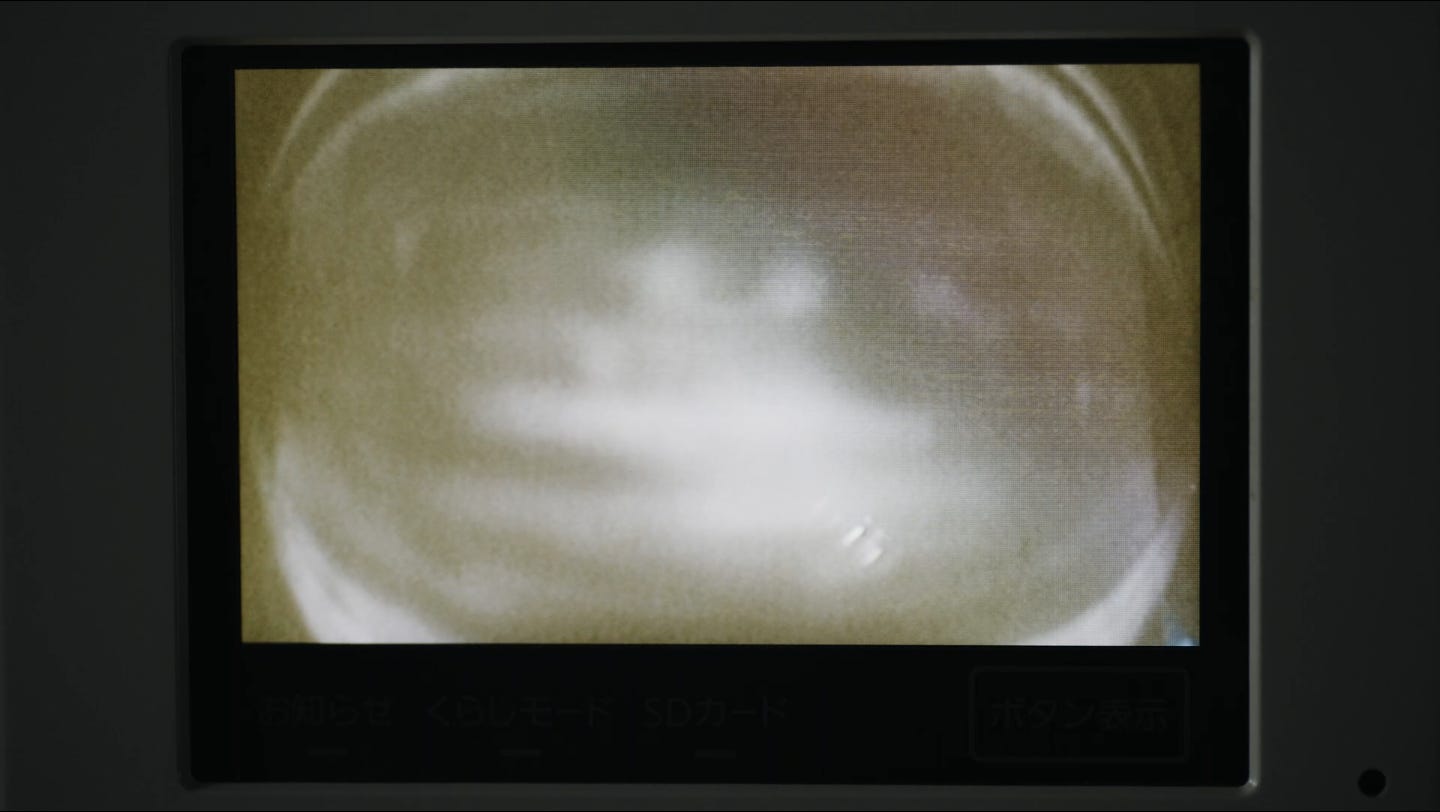
His doorbell rings and the outdoor camera shows a classically Kurosawan image: the distortion of video static, no face at the door, and abyssal foreboding. The Eerie, an absence where there should be presence, here also doubles to reveal perhaps Kurosawa’s simplest and most disturbing gambit: that the elusive chime is in fact a spectral echo of Matsuoka’s doorbell. When he tentatively opens the door, digital switches to film grain. He finds nobody outside, and the train across the street rushes past to create a deafening crescendo with the score’s screeching strings. Matsuoka seems to resolve to something. He retreats into the house, closing the door behind him. Fin.
Kurosawa is hardly one for clarity, but, as many have noted, here his penchant for mystery is in overdrive, dodging any insistence even on a genesis for the sickness and violence that explodes in the film, the chime almost being a red herring for Matsuoka’s brutality. The murder of Akemi is flanked in the film’s structure by two sequences in which Matsuoka is interviewed to be head chef at a local French restaurant. His arrogance leads him to a particularly testy rejection in the second of these, and as Matsuoka stands to leave, a diner is attacked suddenly by another patron with a knife. Matsuoka sees this and leaves, disinterested. Rather than any kind of decisive break in Matsuoka’s personality, his actions across the film are of a Weird accord. We could see him as perhaps Kurosawa’s most singularly evil character, or as an avatar for the aforementioned social rot-without-genesis. The chime doesn’t organise the film in the same way as Kurosawa’s other films are organised around themes, however bizarre they turn out to be. The chime was already there in Matsuoka’s periphery, again returning us to a darkness internal to the society, rather than encroaching on it from the outside.